Membership 2026
Just a friendly reminder that memberships run on a calendar year basis and are now due.
If you haven’t already renewed, please click here to continue your membership.
Please note that current financial membership is required to attend the AVdGS Workshop.
Annual Viol Workshop – 7-9 March 2026
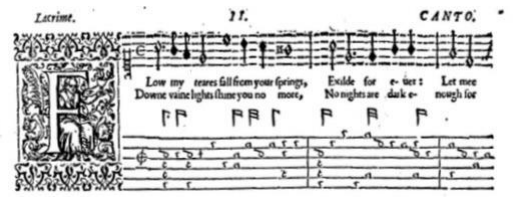
Another friendly reminder that enrolment for the annual Viol Workshop closes 20 February.
Please click here to download the brochure which contains all the Workshop details.
Please click here to enrol in the Workshop.
Ballarat Organs & Fine Music 2026
Artistic Director’s Overview
The Ballarat Organs & Fine Music festival was held between 9-13 January in Ballarat, Clunes and Creswick.
The viola da gamba was intrinsic in several concerts in the festival this year, placing it at the centre of the musical conversation and showcasing both the instrument’s versatility and the richness of the wider viol family.
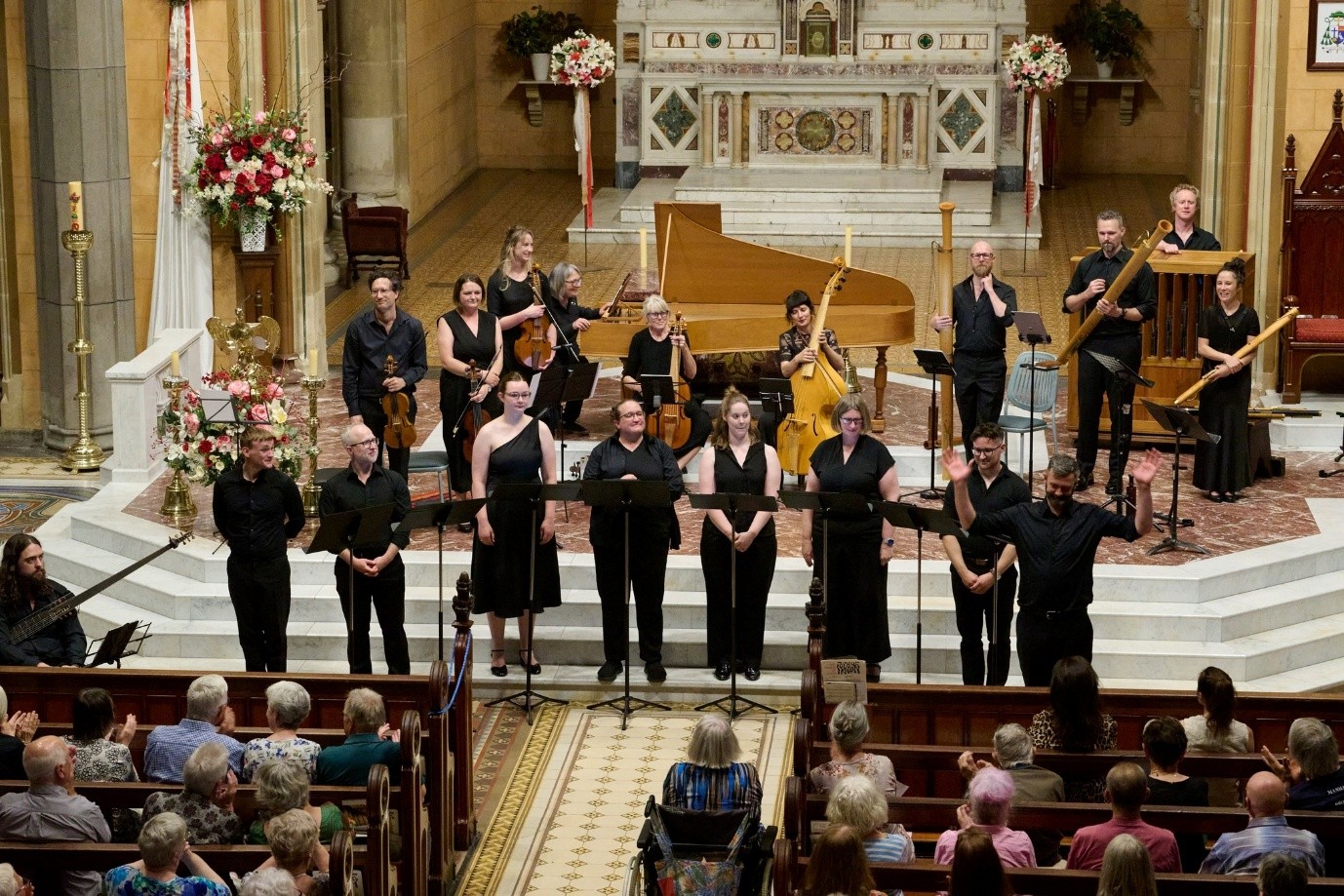
The opening concert, Gloria!, offered a particularly vivid display of consort playing, with treble, tenor and bass viols joined by a G violone which perfectly suited the 17th century German repertoire. Simon Rickard mentions below, the pairing of viols with curtals and other low reeds created a wonderfully blended sonority, especially effective in the polychoral music of Schütz, Hassler and Praetorius. For players, it was a lovely reminder of how naturally viols sit within mixed consorts, supporting and colouring vocal lines while retaining their own expressive identity.
Reeds and Resonance continued this exploration of instrumental colour, further highlighting the dialogue between bowed strings and early wind instruments. The program underlined how shared articulation, phrasing and tuning practices allow these historically related instruments to speak as one, even in complex contrapuntal textures.
The festival closed with a concert of 17th-century Italian music, focusing on continuo-rich repertoire. Here, the bass viol took on a foundational role alongside harp, harpsichord and organ to support the beautiful singing of e21, complemented by the resonant and expressive lirone, whose chordal writing brought a distinctive warmth and emotional depth to the ensemble. The lirone is nearly like a whole consort in a single instrument! For many listeners, it was a rare and fascinating sound world to encounter live.
Across these concerts, the variety of viol types, consort combinations and repertory offered a rewarding snapshot of the viol’s many historical roles, from consort voice to continuo anchor, and lots of inspiration for today’s players.
Laura Vaughan, Artistic Director, Ballarat Organs & Fine Music
www.ballaratfestival.com
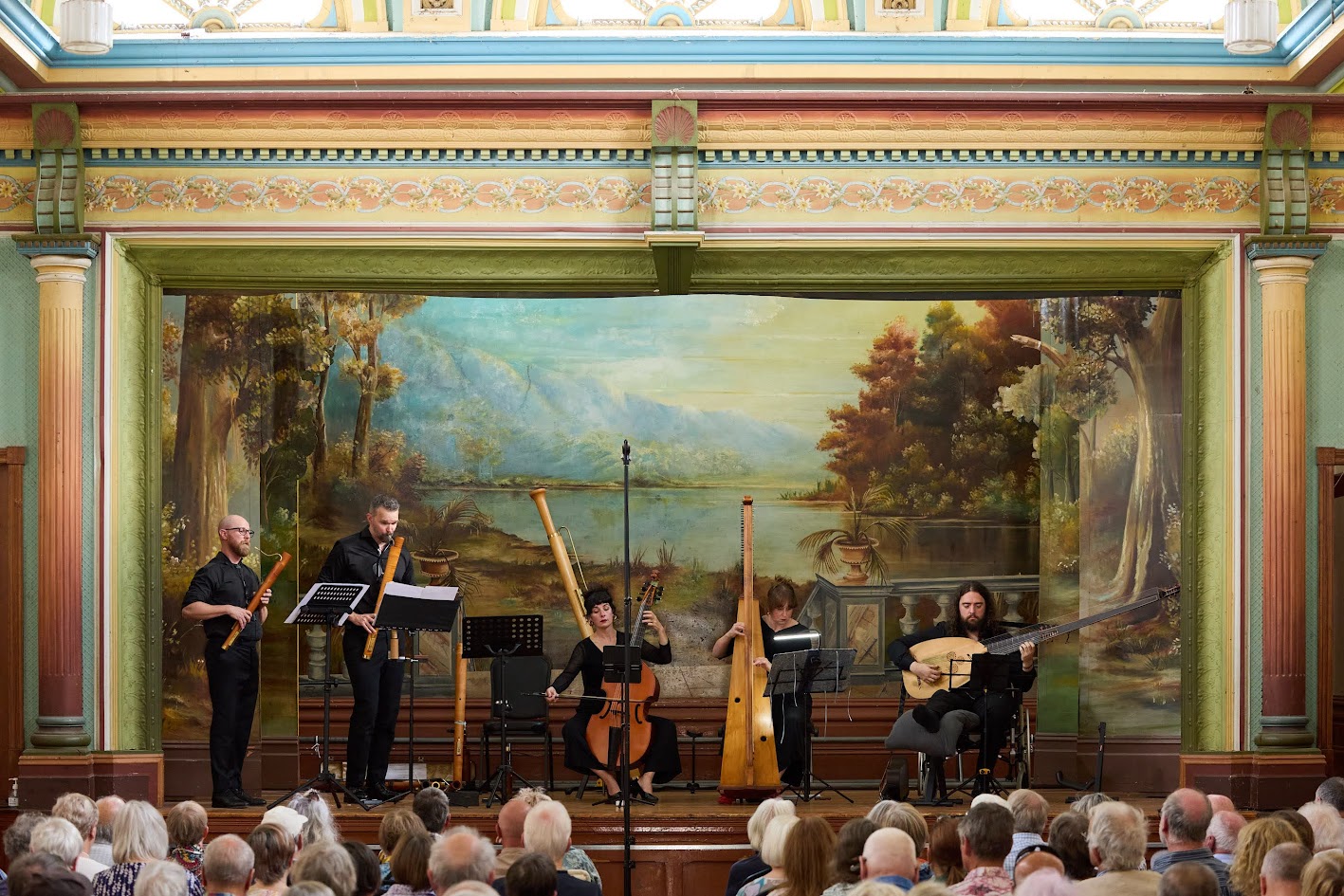
Festival Opening Concert – Gloria!
The opening concert of the recent Ballarat Organs and Fine Music Festival was a program of polychoral music from 17th century Germany. It featured works by Schütz, Michael and Hieronymus Praetorius, and Hassler, composers who have been comprehensively overshadowed by JS Bach today. Yet Bach himself stood on the shoulders of these giants, who introduced the new baroque musical language from Italy during the first quarter of the century.
Accompanying eight singers from the Consort of Melbourne were two instrumental consorts; Consortium Viols, and Unholy Rackett, underpinned by a basso continuo section of theorbo, harpsichord, and organ. The reedy timbre of viols complements renaissance wind instruments perfectly. The viol consort comprised a treble, two tenors, and G-violone, whilst on the wind side were alto, bass, and greatbass racketts, as well as alto, tenor, bass, quartbass, quintbass, and the mighty octavebass curtals; the first time these large instruments have ever been heard in Australia.
Simon Rickard
Versailles in Love
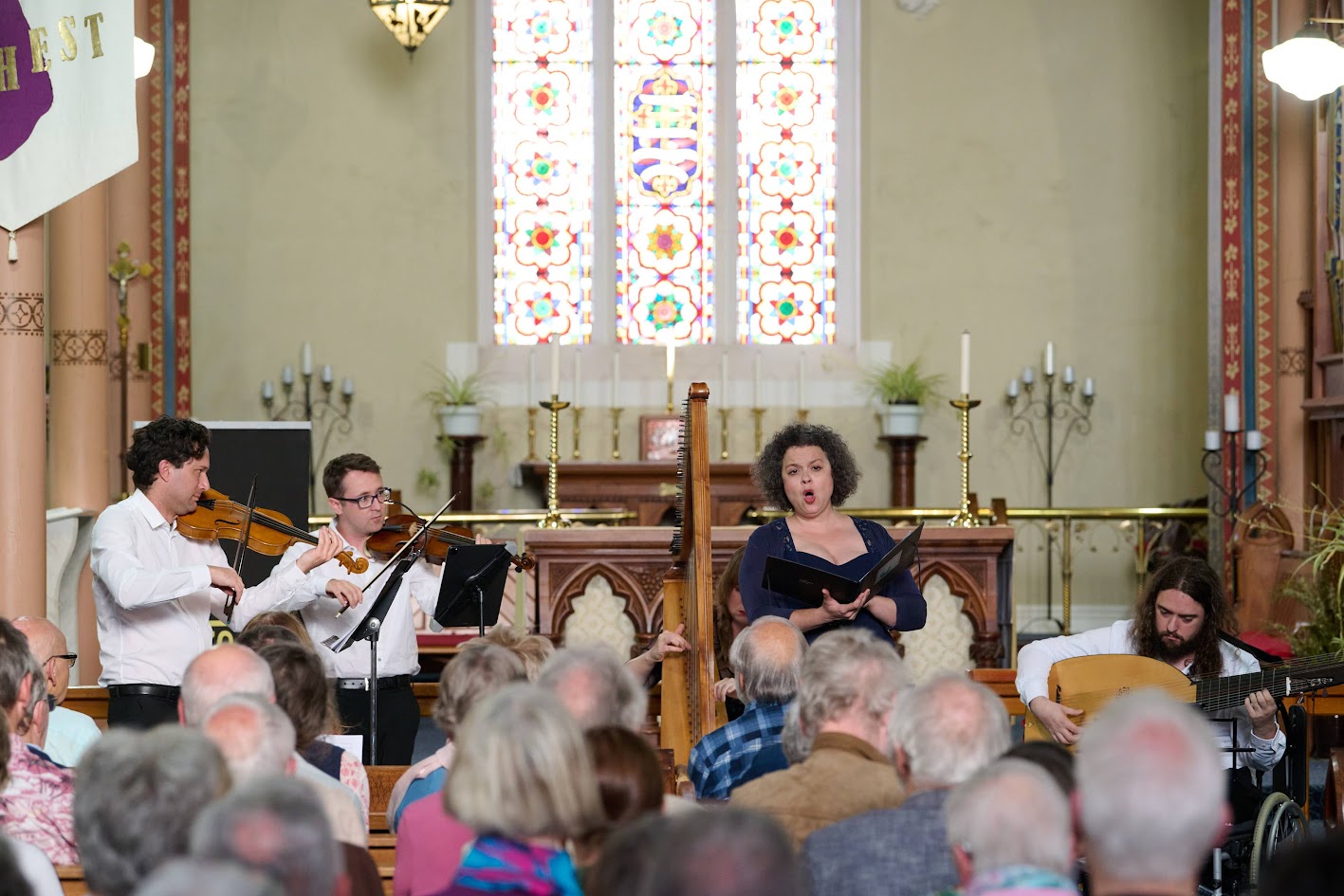
In total contrast to the opening concert of the Ballarat Organ & Fine Music Festival was the intimate Versailles in Love concert. Voice, two violins, triple harp and theorbo made for an elegant presentation of music from the 17th century court of Louis XIV. The composers represented were Marais, Lully, Lambert, Ballard, Couperin, Fischer, Stuck; not every one of them familiar in today’s performance repertoire making it all the more exciting to hear their work. And to know that they were encouraged in their creativity by Louis XIV who also often joined in performances at Versailles, that they worked with the likes of Moliere, were published by Ballard himself. And had many other connections as well. They were the days.
Myriam Arbouz, soprano, brought drama and feeling alive, from the most sensuous air de cour to high operatic drama, equally so the two violins. The continuo provided by the theorbo and the harp gave a richness of texture to the whole which ranged from the most delicate to the most dramatic. It was an exceptional concert and one to be remembered. As was this year’s iteration of the Festival itself with its innovative programming and performances, its hospitality and determination to go head-on into early January Ballarat weather when you can freeze or fry. This year presented challenges to artists and audience alike – the music worked magic.
Jo Parkes
Abel: the Drexel Manuscript, 29 Pieces for Viola da Gamba
Alejandro Marías, viola da gamba
Brilliant Classics, September 2025
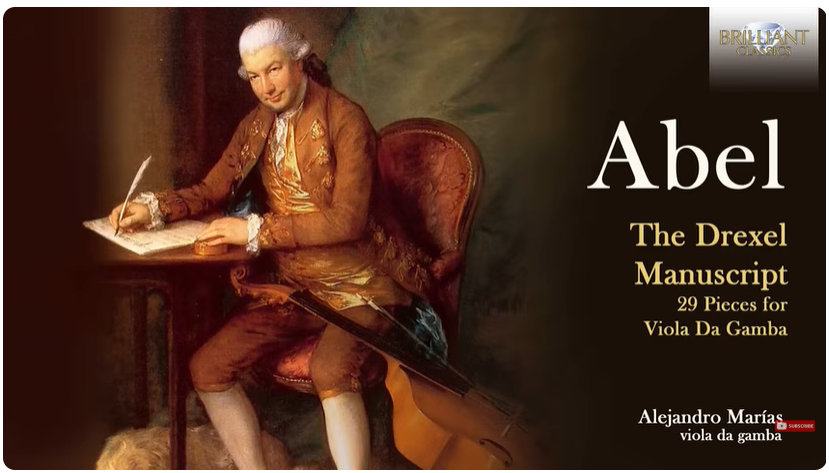
This is the most recent recording of the 29 pieces for unaccompanied viol by Carl Friedrich Abel (1723 – 1787), considered to be the last of the great viol virtuosos before our own time. These pieces have been recorded before, by Susanne Heinrich in 2007, Paolo Pandolfo in 2009, Petr Wagner in 2016, Ralph Rousseau from the Netherlands and Gaetano Simone (a student of Pandolfo) both in 2023, Krzysztof Firlus of Poland in 2024. And many more people have recorded substantial numbers of these works, presenting them with others. This recording then, can be approached either as its own thing, or as a continuation of a noble line of previous recordings.
Carl Friedrich Abel was possibly the last great virtuouso of, and composer for, the viol, until its rediscovery in the early 20th century. His musical credentials were impeccable: his father was a noted virtuoso on viol, and who also played violin and cello; he had played with J.S. Bach in Cöthen. (It may be that Bach’s sonatas for viol and harpsichord were written with the elder Abel in mind.) The young Abel was in Leipzig at the same time as Bach, who may possibly have taught him. Bach certainly recommended that Abel be given a position in Hasse’s orchestra in Dresden. Abel also met the young Mozart and his father during their tour of Europe, and Abel gave Mozart some lessons. In the second half of the 18th century, when Abel was in London, he teamed up with J.C. Bach (known as the “London Bach”, and youngest son of J.S. Bach), and the Bach-Abel subscription concerts were for many years a fixture in the musical life of London. Abel was also a great friend of the painter Thomas Gainsborough, whose portraits of Abel with his viol are some of the greatest paintings ever of a musician with their instrument. Gainsborough was a very keen amateur viol player (he owned 5 instruments), and there is some thought that Abel composed at least some of these pieces for him. If that’s the case, then Gainsborough must have been a very good player indeed.
These pieces weren’t published at the time, but sort of knocked around in manuscript until they ended up being purchased by Joseph William Drexel in 1877, hence this collection now being known as the “Drexel Manuscript”.
The pieces demonstrate a compositional excellence – Abel was good enough a composer that one of his symphonies was for a time misattributed to Mozart (Mozart had copied it out to learn from it) – as well as at times an improvisatory style which may well approximate Abel’s own public improvisations, at which he was a known master. These are not “classical” works in terms of Mozart, Haydn, or the younger Beethoven, but they are also not baroque. The show more a galant style, with sometimes lavish ornamentation. However you like to describe these pieces, they are thoroughly delightful. In an early edition (Dovehouse Editions, Canada, 1982), the editor, Murray Charters, claims that these pieces give the viol player “a unique opportunity to play ‘Mozart’.”
For this recording, the artist is Alejandro Marías, currently professor of viol and baroque cello in Seville, and a formidably excellent player.
These are pieces which require a very solid technique: fast passage work, leaps all over the instrument, and soulful passages in chords (including some lengthy passages in thirds) along with wonderful arabesques. Marías is well up to the challenge, and as far as I’m concerned, these pieces could not be better played. Abel wrote for a six-string instrument, there are no notes below D2; however, there are pieces which call for very high notes, up to A5, a total range of three octaves and a fifth. (As a curiosity, Gainsborough’s first portrait, in 1765, shows Abel with a seven-string instrument, but his second portrait, in 1777, shows Abel with a six-string instrument.)
Marías has a very unfussy, unmannered style, and seems to want to let the pieces speak for themselves, rather than drowning them in wild changes of pace and volume and sundry other “interpretations”. This is not to say that Marías’ playing lacks interest or drama – there’s plenty of both – but this originates in the music. His dynamics, rubato, articulation, are never overpowering, but carefully played in a way that maximises the musical expression. This is playing of the highest artistry and musicianship.
Marías also plays the pieces in order of their appearance in the manuscript. Some other players (and editors), try to group the pieces into suites. But there’s no indication in the manuscript that Abel intended any grouping, so playing these as suites is very much an editorial or interpretative decision.
His viol has a splendidly direct sound, slightly edgy, but a treat for the ears. This is the sort of sound for which the viol was always praised; listening to Marías – especially if you’re not a viol player – you hear the viol as a magnificent instrument in its own right, rather than as a sort of sonically diminished cello. And this is just as it should be.
I haven’t listened to all the other recordings, so I can’t compare Marías’ playing with that of other players. All I can say is that this is a splendid recording of excellent music, and well worth your time.
The music can be heard on YouTube, and the manuscript is available on IMSLP at https://bit.ly/4cha03F. Recent editions have been published by Edition Walhall: https://bit.ly/401hFM0, and Edition Guentersberg: https://guentersberg.de/noten/en/g333.php.
Check it out, listen, and be inspired!
Alasdair McAndrew
Classifieds
Instruments for sale
A small consort bass viol (Tenor/Bassgambe) made by Walter Uhlig in Mittenwald in 1962. Birdseye maple back and sides, German spruce top. Purchased in Germany, fully restored by Sachar Amos in 2025. My asking price is $9,000 (a professional valuation for the instrument following the recent repairs put the instrument as worth $12,000). Available to be played in Melbourne by arrangement.
Dimensions (see images):
Total length: 116cm
A: 50.5cm
B: 66.5cm
C: 47.5cm
D: 36cm
Please email: heilbronjonathan [at] gmail [dot] com for more information.


Instrument for hire
AVdGS is pleased to introduce our instrument hire program.
We currently have a tenor viol available, complete with bow and hard case.
To view full details, including hire rates and conditions, please click here
We are also welcoming donor instruments. If you have an instrument you’d be happy to contribute to our loan program, we would love to hear from you.
For more information about the hire program contact info.avdgs@gmail.com
Thanks for reading and happy viol-ing!