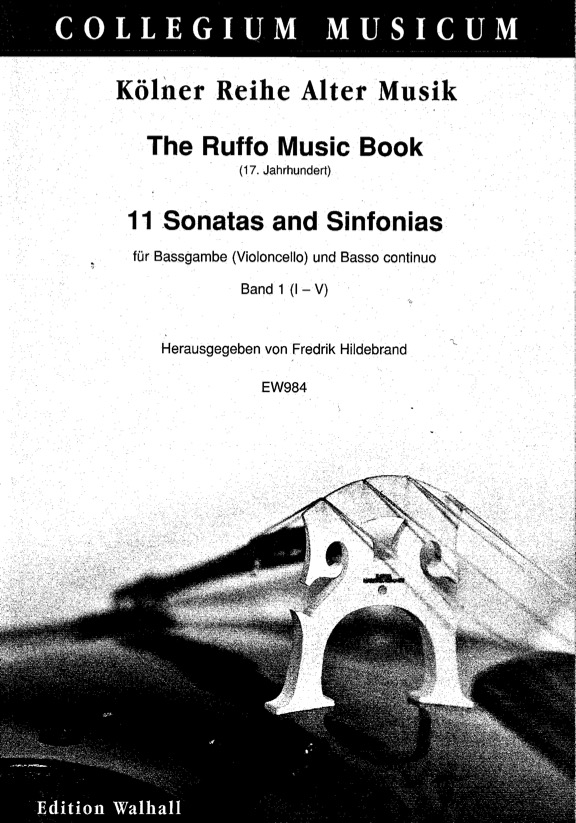
Our understanding of the solo repertoire of the bass viol in Italy during the last half of the seventeenth century has been immeasurably increased with the publication of these two volumes, presenting an edition of a manuscript held in the Rarities Collection of the Library of Music and Theatre in Stockholm.
This manuscript is of Sicilian origin, and traceable to the Ruffo family, members of which were noted connoisseurs and patrons of the arts, although the exact member of the family to whom these books belonged (the books are merely stamped with ‘DPR’, perhaps indicating Don Placido Ruffo) is unknown. The books contain eleven extended works, identified as ‘sinfonia’ or ‘sonata’, by three named composers (Don Fiderico Ruffo, Don Francesco Ruffo, and Filippo Muscari) as well as one incerto. Of them, only Filippo Muscari’s career can be described in any real detail (he was organist at the Cathedral of Messina), although all of them were presumably Sicilian or Calabrian figures. Two works bear dates (1682 and 1690) and one of them is entitled La Pietra è Paula, perhaps intended for the Feast of Sts Peter and Paul. There appears to be no real distinction between the works entitled ‘sinfonia’ and those entitled ‘sonata’: all are multi-movement works, designated usually according to speed, although there is the occasional canzona, balletto, and so forth.
Although the edition contains an introduction by the editor that provides all the basic information players are going to need to tackle this music, Bettina Hoffmann wrote an extended examination of the works in the 2018 edition of The Viola da Gamba Society Journal (‘Viol Music in the Palazzo Ruffo, or How the Viola da Gamba Came to Sicily’) that will be essential reading for those who want to go further. In particular, Hoffmann draws attention to the quite extraordinary tuning of the bass viol for which the works were written — C, D, G, B, e, a. With the exception of the reasonably complicated multiple-stop movements to be found in several of the sonatas, it is not really necessary to have a viol tuned in this way to play the music, but the adoption of this tuning by the volumes is one of many idiosyncratic oddities in the music.
Truth be told, none of the music in this collection is really remarkable. Some of it reminded me of what Annette Otterstedt once insightfully remarked of the music of Schenck — that some of it is so mind-numbingly complicated that you might reach the end of learning it only to wonder whether the musical substance really merited the effort. Although I did not learn the movements filled with multiple stops thoroughly (e.g. Sonata VIII, Largo; Sinfonia XI, Largo), my impression of learning the skeleton of them was that you would spend much more effort learning them than they deserved. There is also an irritatingly high number of moto perpetuo movements where bar after bar of semiquavers stands in the place of any real interest (Sinfonia I, Allegro; Sinfona II, Fuga; Sonata VI, Allegro; Sinfonia XI, Fuga). More or less contemporary with the works of Corelli or Torelli, these sonatas show reasonably few signs of the classical poise of those composers of the end of the seventeenth century and the start of the eighteenth century — ideas begin and then wander in their own directions, growing organically (and sometimes not). That can certainly be charming, but it can also leave some of the music sounding undigested and ill thought out. The best movements are often the slower ones, cast in arioso style and often in 3/2 and notated in croches blanches (e.g. Sinfonia I, Largo; Sinfonia II, opening movement), which allow plenty of scope for expressive playing. Players are going to be hard pressed to find entire sonatas that could make their way onto concert programmes, but there are some — Sinfonia III, Sinfonia V, and Sonata X are all fine and varied works, with good development of ideas and sensitive handling of the instrument. Sinfonia V in particular, with its long and highly varied opening movement, could easily fit somewhere on a solo recital programme. In general, the style of music is probably closest to someone like Schenck, although it often lacks the tautness he got from the German traditions of composition.
As is usual for Edition Walhall publications, the presentation of the edition is impeccable, with separate single pages for dealing with those pesky page turns.
— John Weretka