AVdGS Viol Workshop Series
Workshop 1
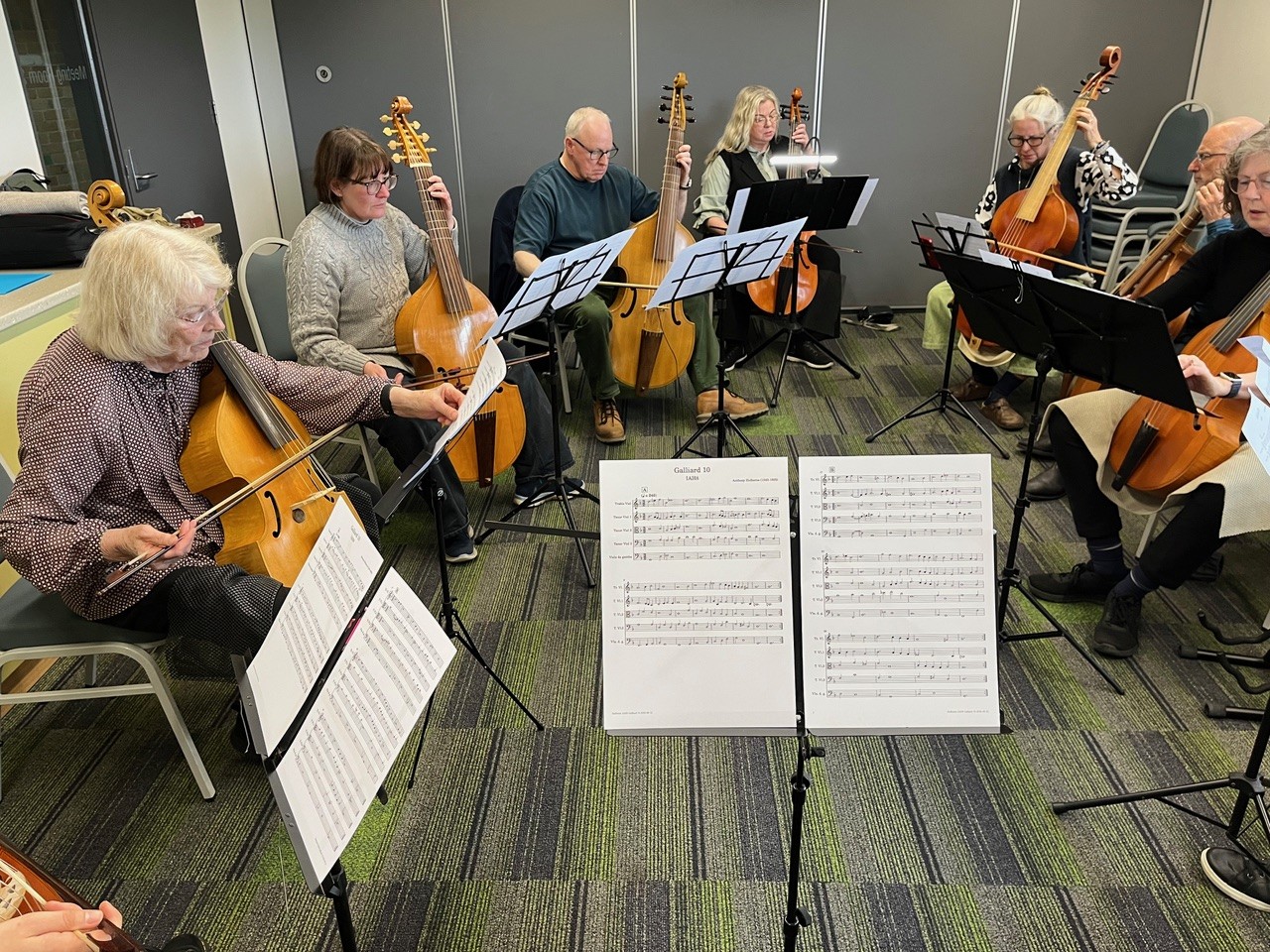
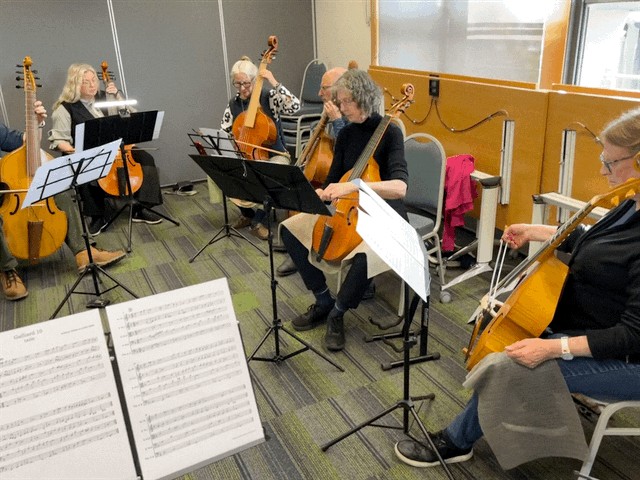
The inaugural workshop of the series took place on 23 August 2026. The AVdGS hired two Meeting Rooms on the ground floor of the Batesford Community Centre. We had expected the Centre to be deserted on a Sunday afternoon, but instead, it was a hive of activity! The upper floor was host to the meeting of an enthusiastic evangelical group. However, the sound-proofing within the building was effective so that their singing did not disturb us and they were not bothered by our presence.
The workshop was attended by ten players – six basses, three tenors and a sole treble. Fortunately, our tutor, Madison Furlan, was able to borrow a bass to double the treble part.
We successfully worked through a set of Pavans in five parts by Ignatius Anthony Holborne that fulfilled the desired “not too difficult, but offering some challenges” standard. The players agreed that having a professional tutor was very valuable. They suggested that we should allow for this at alternate workshops in the future.
Encouraged by the attendance and feedback, we shall organise a regular bi-monthly series of workshops.
Workshop 2
The next workshop is planned for Sunday, 15 November 2026 at the Batesford Community Centre, Meeting Rooms 1 and 2 from 2pm to 4pm. The cost will be $10 to cover the venue hire.
In recognition of the approaching festive season, we shall study William Byrd’s setting of “Oh magnum mysterium”. We shall also include a selection of John Dowland’s 4-part songs.
Please RSVP to dawclarke@gmail.com with an indication of the instrument you play e.g. Treble, Tenor or Bass.
PDF copies of the works to be studied will be distributed to those who will be attending.
To keep the ensemble balanced, we particularly encourage Treble and Tenor players to join the event. We hope that by studying 4-part works we shall be able to ensure that every part is doubled.
Knobby Clarke
Cambridge Early Music Summer School
In the last week on July, I headed to the small town of Hitchin for the Cambridge Early Music Summer School. Hitchin is about half way between Cambridge and London and has a lovely Edwardian mansion, Benslow Music that is now used for residential music schools.
The Cambridge Early Music Society runs several summer schools. One was dedicated to presenting a Purcell opera another to the music of Palestrina, but the school I chose focussed on the Song of Solomon. The focus was on Renaissance vocal settings with an accompanying consort of five viols.
We were using Renaissance viols, some of which were based on instruments by Giovanni Maria de Brescia and Antonio Brensio. Philip Thorby, founder and director of Musica Antiqua has commissioned a consort of viols for a recording of music by Isabella D’Este, Marchionesse of Mantua that are based on a painting of Lorenza Costa (c.1460-1535)
Renaissance viols have no bass bar and no soundpost , making the sound more muted and mellow compared with Baroque viols. I especially noticed this on the treble. The shoulders were quite sloped and there was a variety of distinctive scrolls. One with a horse’s head was nicknamed as Mustang Sally.
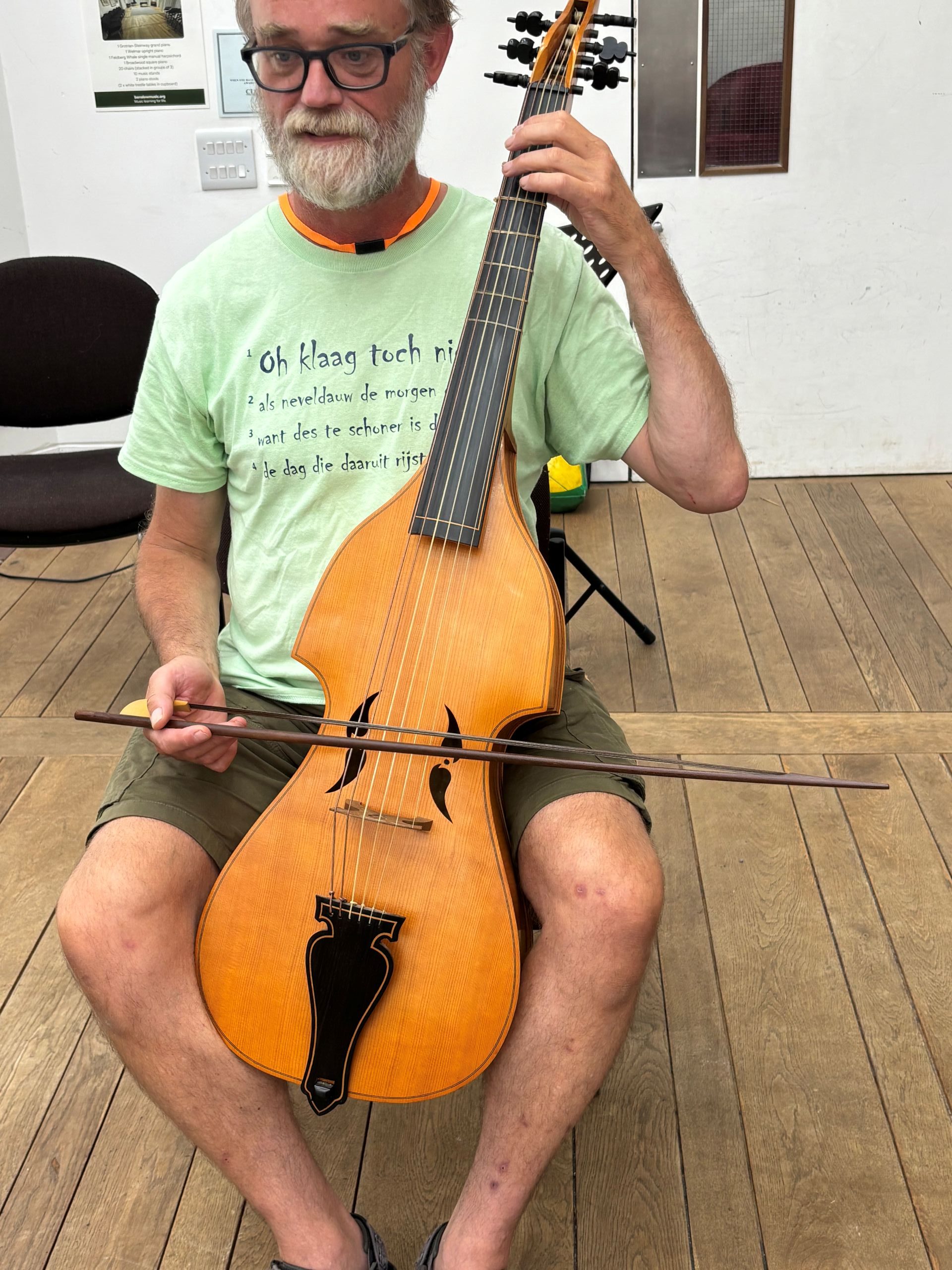
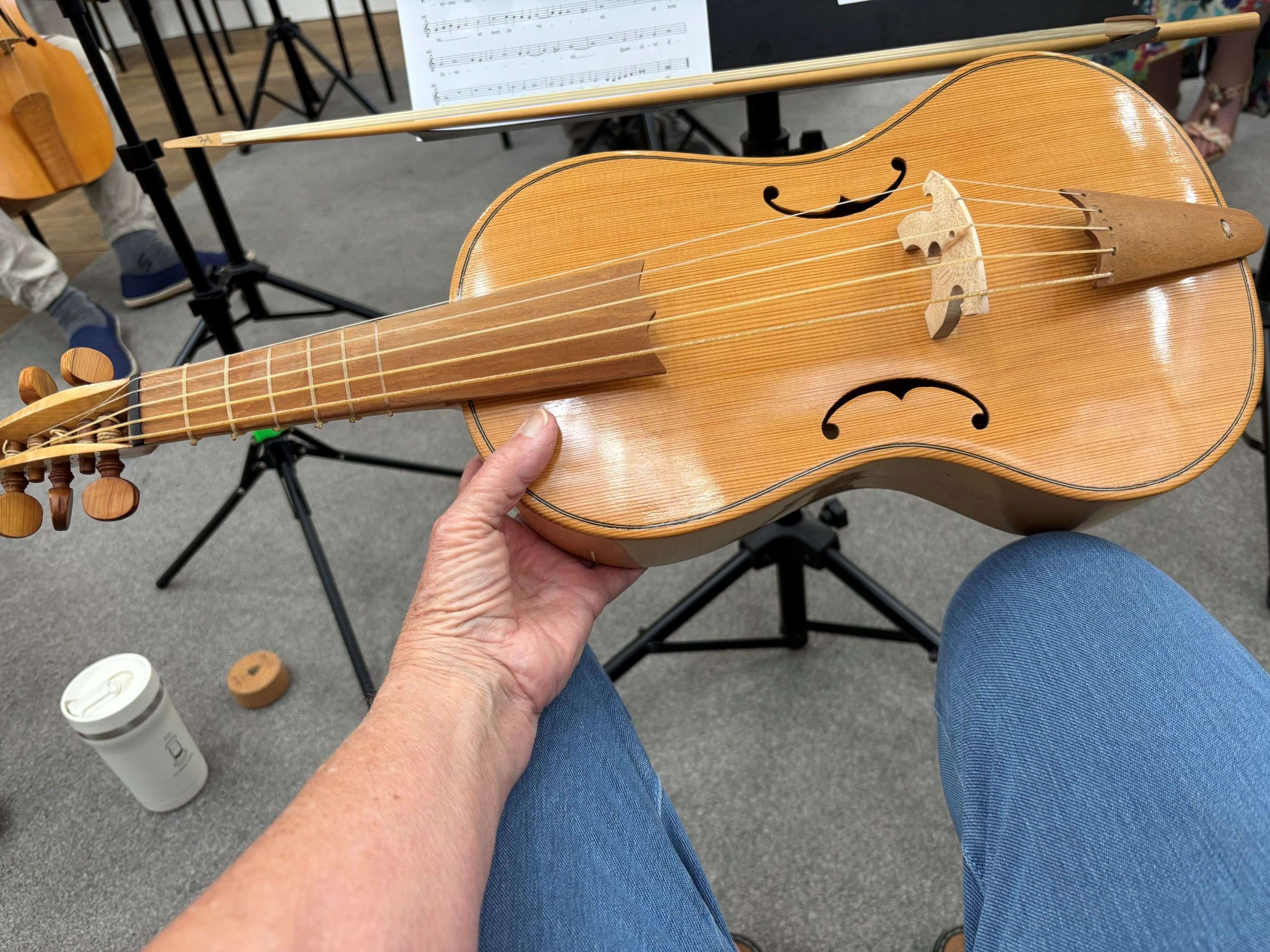
Other viols were more creative in their design. I played a treble that resembled a small ukulele, having no blocked corners. I think this was a first attempt by the maker as the pegbox was too narrow for six strings, so the bottom D was missing and the neck was too small for seven frets, so there were only six! I did get used to it eventually as the other treble had an incredibly high action.
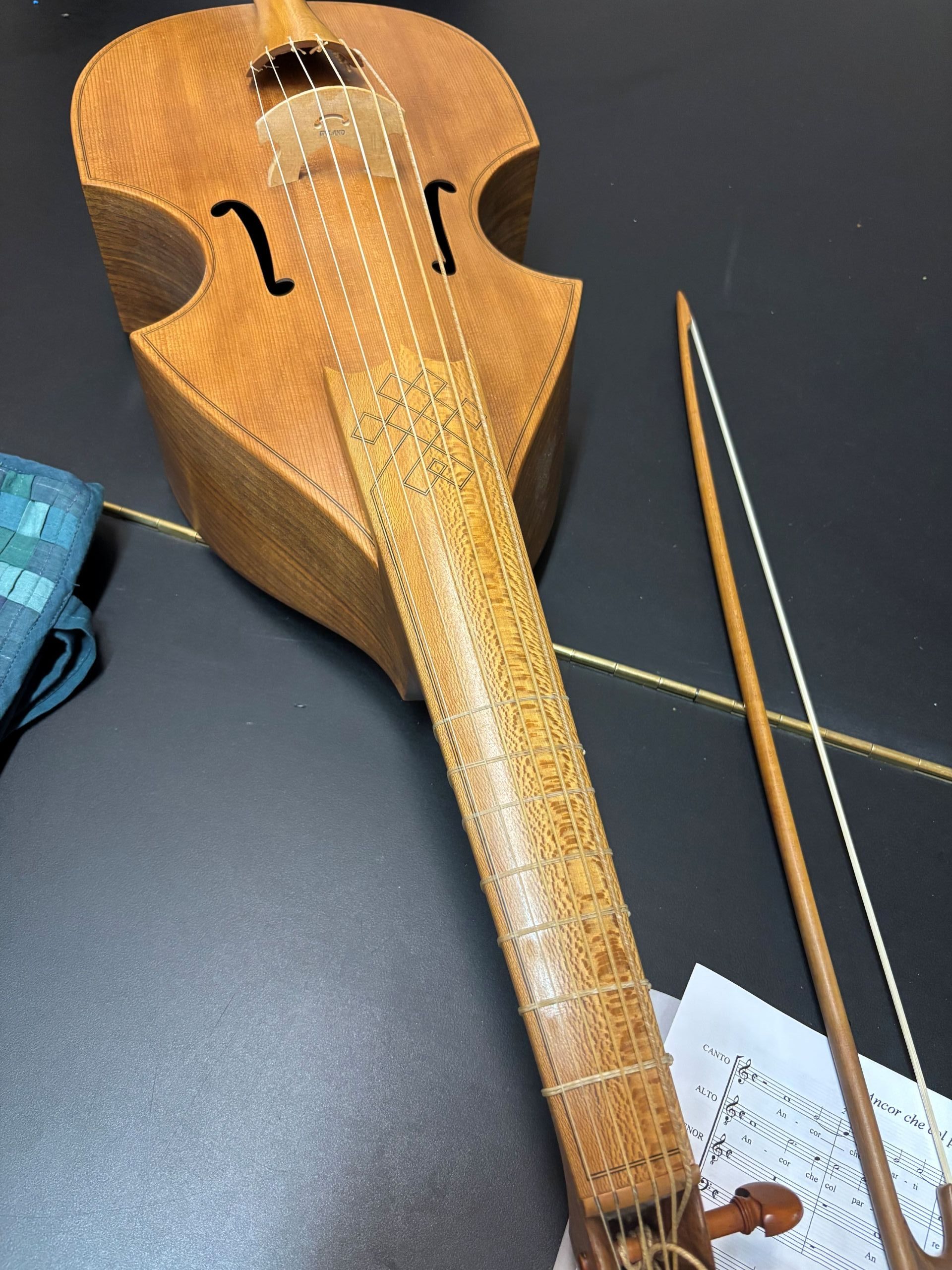
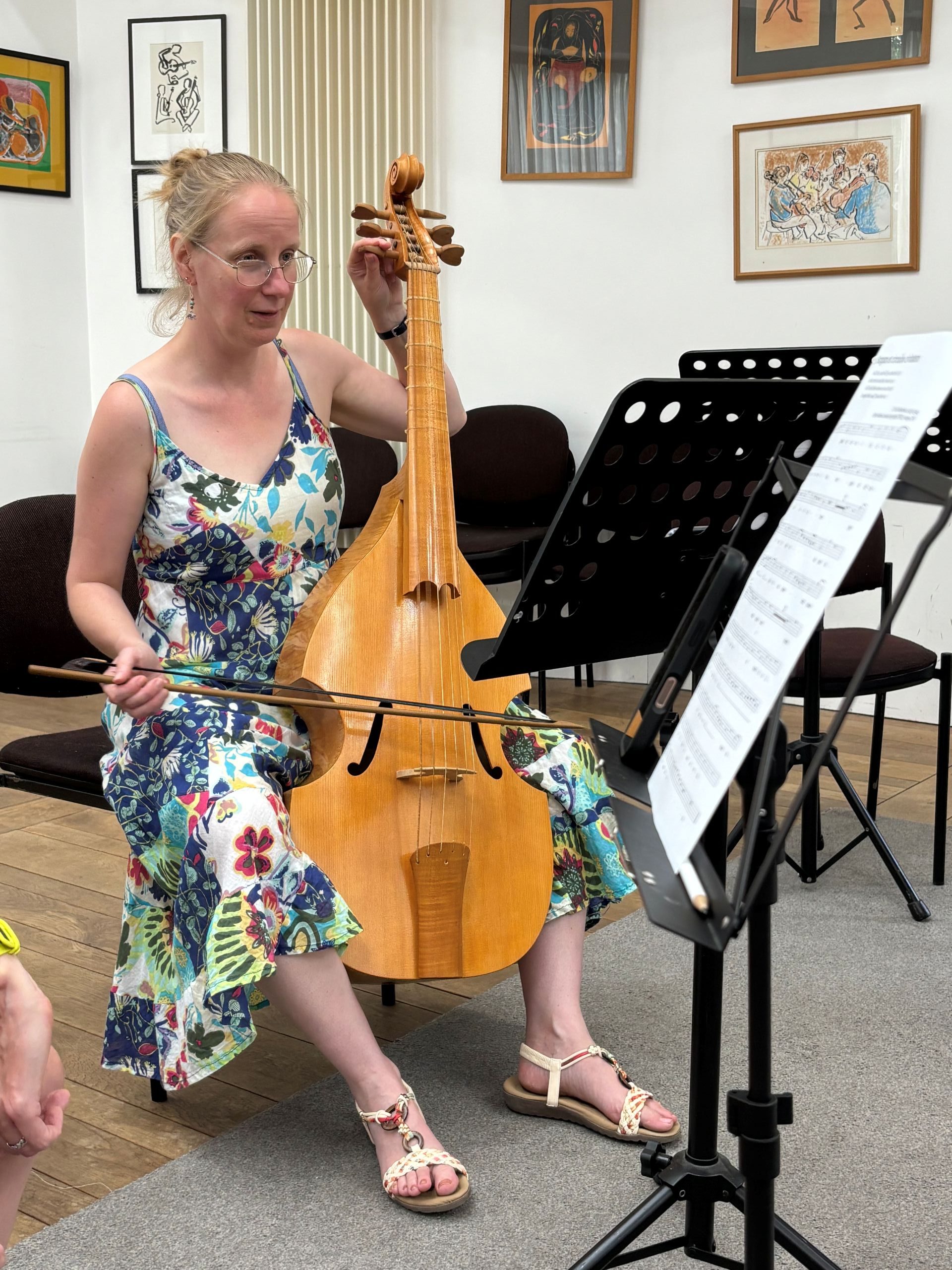
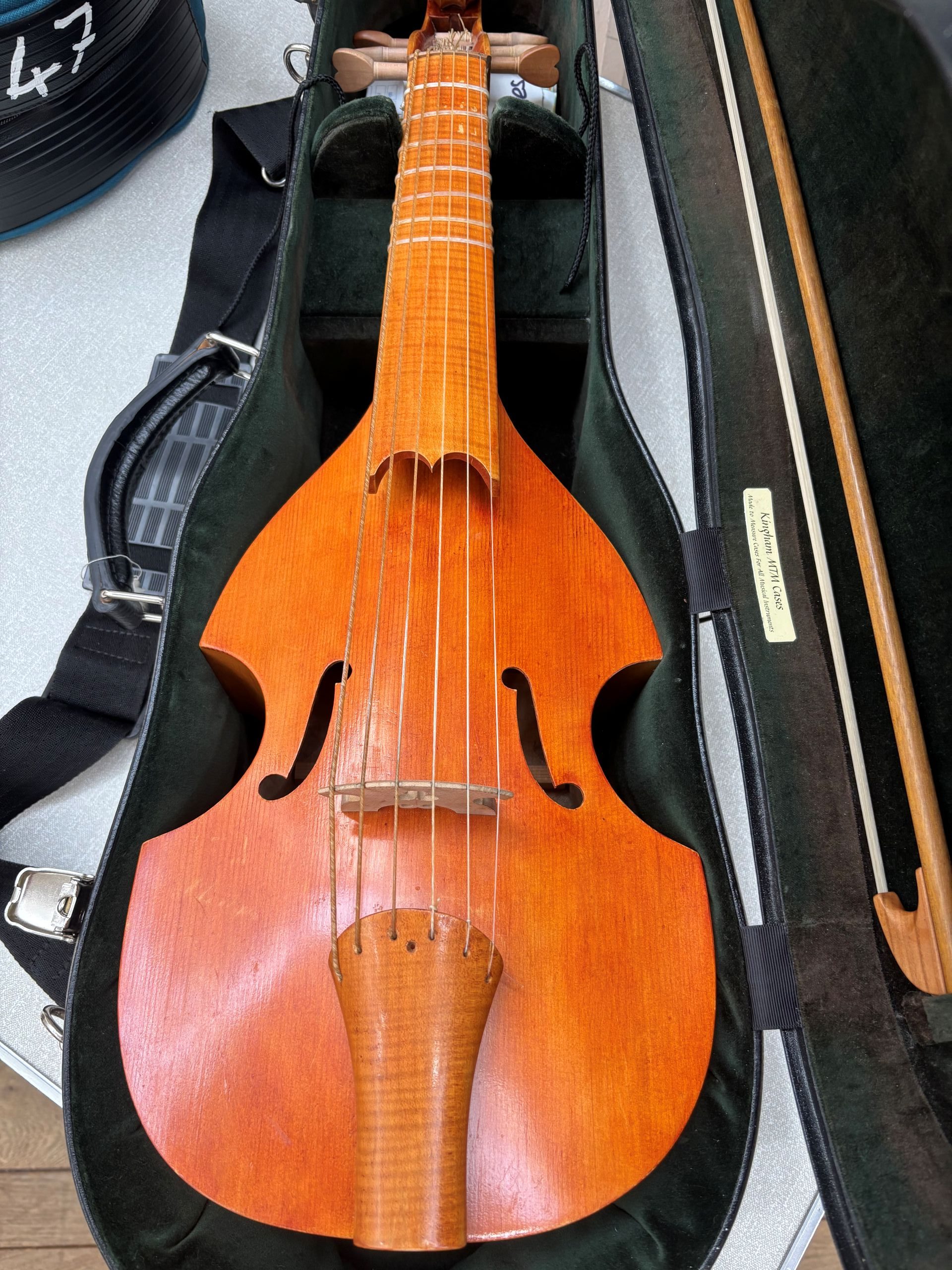
Another viol which was new to me was the A Tenor, slightly smaller that the G Tenor and tuned one tone higher. I wasn’t quite sure why one would need a viol tuned one tone higher than the usual tenor, aside from developing new areas of your brain to cope with the confusion! Apparently, some keys and ranges fit better on the A Tenor.
As we were basically accompanying vocal consorts, the music was very melodic and limited in range. Most of our attention was focussed on tone, blending with voices and placing the emphases and phrases to mimic the vocal lines.
When we had some singer free time, we played arrangements of Renaissance vocal pieces.(!) So this school is not one that has a wide repertoire.
Renaissance viols are tuned to 440. No one had a good explanation for this, but I imagine that if you had perfect pitch, playing at 440 would be easier.
One evening the entire school tackled the 18 part Palestrina Missa Tu es Petrus. The singers were divided into three choirs and six viols accompanied one choir, one was unaccompanied and the other was supported by six recorders. Somewhere in people’s luggage there were six recorders including an IKEA-type flat-pack contrabass and great bass, assembled with a handy Allen key!
This was definitely a niche school where you could learn a lot about Renaissance music. I am thinking I should visit some others schools, perhaps in Ireland, to see what they can offer.
Rachel and I met up with Suzanna and visited the Royal Academy of Music in London, specifically to see their viol collection which included a Barak Norman.
Rosemary Evenhuis
Floyds Row: The Carlisle Sessions
Musicians:
Andrew Arceci – viola da gamba (viol), bass, cittern, guitar & mandolin
Asako Takeuchi – violin & mandolin
Chris Ferebee – cittern, gittern, guitar, mandolin & lyre
Emily Noël – soprano, autoharp & Appalachian dulcimer
George Lykogiannis – accordion & piano
George Lernis – percussion
“Floyds Row” are a group of expert musicians who explore old and forgotten music, and who bring that music to life with expert playing, infectious enthusiasm, and unbounded energy. I find their music utterly beguiling and entertaining in the best sense. This is not background music, but music to fill the mind, and music that makes the world seem a better, happier place.
It’s worth noting that this is not “early music” as we might understand the term; it is more in the folk traditions of Britain and America; but rarely is folk music played with such consummate skill as here.
This recording is an EP of five pieces, so named as they were recorded in the town of Carlisle, Massachusetts. It is quite fitting then, that the first piece should be “George Washington’s Favorite Cotillon [sic]”. The name comes from “Asa Wilcox’s Book of Figures”, the author being an 18th century American dance master. This book is not a book of tunes, but a book of dance descriptions. It can be enjoyed online at the Newberry Library. On the contents page it is wonderfully titled “Gorge [sic] Washingtons Favourite”; on the dance page itself “G. Washington’s Favourite Cotillon”. A cotillion is a sort of social dance originally for four couples. George Washington was a very enthusiastic and accomplished dancer (in his time, dances and balls were also occasions for some serious networking), but there is no indication linking him to this dance, other than the name. It would seem that Wilcox was harking back to an earlier time (such as many of pieces by Dowland and his contemporaries) in naming a piece as somebody’s “favourite”. The tune itself, according to George Lykogiannis, was found by him in a book of old American tunes, then transcribed and arranged. Whether the tune is an American original, or is an arrangement of an old British tune, I don’t know. Whatever its history, the tune is wonderfully simple and upbeat, eminently danceable, and played with enormous energy and gusto. In my mind I could see the knee-breeches and periwigs of 18th century gentlemen bowing to their partners and taking to the floor. After listening to it with much delight, it was very nearly my favourite as well.
Next is an old Scottish ballad “Henry Martin” (which is listed under various different names in various ballad collections); it seems to have first noted in the early 1600’s. The story tells of the youngest brother of three who goes to sea as a pirate to reclaim the family fortune. The singer is soprano Emily Noël, whose rich, clear, generous voice is perfect for this music. I do love a good ballad, and this rendition is a corker. This was one of the ballads collected by the American folklorist Francis James Child, as both an early version “Andrew Barton” and a more recent version as here.
Another ballad is next, called here “Jackaroe”, although as with almost all old ballads, it exists under a multiplicity of names. It tells of a woman who disguises herself as a man (called Jackaroe) to board a ship to save her lover, a sailor. It was very popular in Britain in the early 1800’s and also in America. Several versions have been recorded from Arkansas and Kentucky. As you’d expect by now, it’s splendidly played and sung.

The next piece is a sort of amalgam of two pieces from Playford’s “Dancing Master”: “Maiden Lane” and “KettleDrum”. This starts off with the viol (played with great sensitivity by Andrew Arceci) playing a rich chordal passage very much in the lyra viol style. In passing, it may be noted that a little-recognised virtue of the viol is its flexibility; not only can it be used in music from the 1500’s onwards, but it also sounds quite wonderful as a folk instrument. After the introduction the viol leads into the tune, to be followed by the violin and later the accordion. This is a piece in which the violin takes a starring role, and Asako Takeuchi’s playing is quite wonderful (but of course). There is also a quite uninhibited and impressive percussion solo, after which the melody instruments leap in for a rip-roaring finish.
The final piece is “Robin Hood and his Huntes-men [sic]”, which has been composed by the band themselves. It sounds like a folk piece, and indeed I’d say it was firmly in the folk tradition, but it has a stylish edge which is quite the band’s own. This is again an occasion to revel in Emily Noël’s voice, of which I can’t get enough. There are innumerable Robin Hood ballads, some very old indeed, and this wondrous piece takes bits from some of them and transforms them into a lovely result that is old and new at the same time. It’s really well done.
Just listen to this recording, and enjoy it!
The Carlisle Sessions are available on streaming services and for more information and links to recordings go to www.floydsrow.com
Alasdair McAndrew
Reminder – Annual General Meeting
The Annual General Meeting will be held online on Sunday December 13 at 6pm.
Please put this date and time in your calendar now!
The meeting URL, agenda and minutes from the 2025 AGM will be distributed before the meeting. Nomination forms for positions on the Committee will also be circulated.
This is an important meeting to attend, as one of the main items of business will be the election of the Society’s Committee for 2027, including the President, Treasurer and Secretary, as well as other Committee members.
If you would like to join the Committee and help shape the activities and direction of the Society in 2027, this is your opportunity to put yourself forward. We would love to see new members get involved!
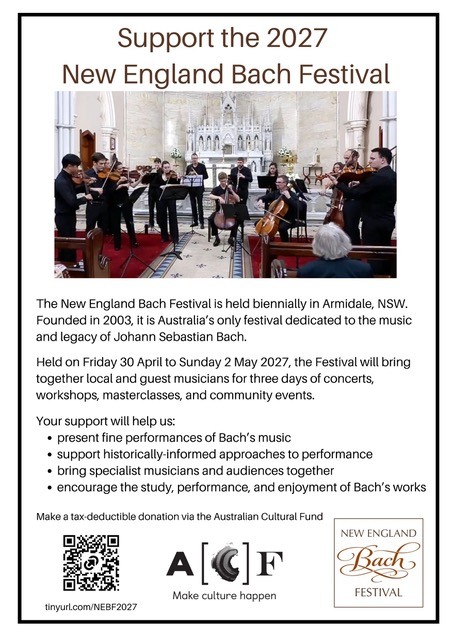
The New England Bach Festival
Instruments for hire
AVdGS is pleased to advise that we have an instrument hire program.
We currently have a tenor viol available, complete with bow and hard case.
To view full details, including hire rates and conditions, please click here
To grow our hire program, we are also welcoming donor instruments. If you have an instrument you’d be happy to contribute to our loan program, we would love to hear from you.
For more information about the hire program contact info.avdgs@gmail.com
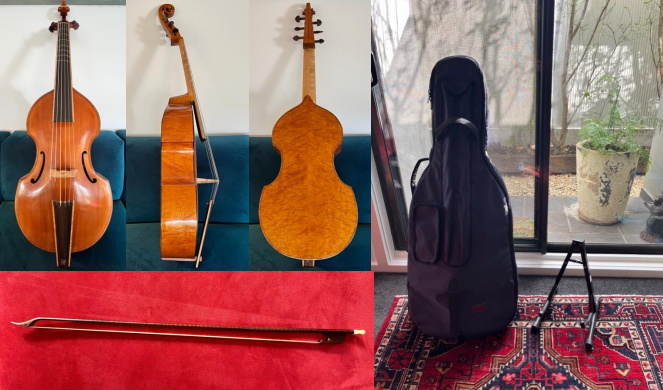
Second hand instrument for sale
A small consort bass viol (Tenor/Bassgambe) made by Walter Uhlig in Mittenwald in 1962.
Birdseye maple back and sides, German spruce top. Purchased in Germany, fully restored by Sachar Amos in 2025.
Bow, soft case, and instrument stand included.
My asking price for everything is $10,000 (a professional valuation following the recent repairs put the instrument alone as worth $12,000). Available to be played in Elwood by arrangement.
Dimensions:
Total length: 116cm
Fingerboard length: 47.5cm
Vibrating string length: 65.5cm
Lower bout at widest point 36cm
Please email: heilbronjonathan [at] gmail [dot] com for more information.
Thanks for reading!!
We look forward to catching up with you all at the Annual General Meeting.
Until then, happy viol-ing!!